
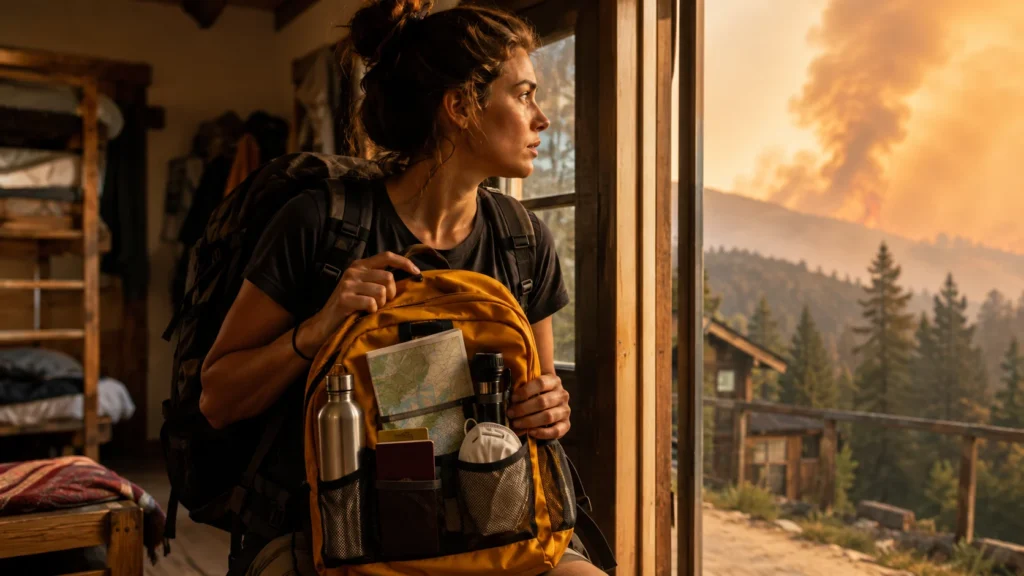
The first sign of trouble may not look dramatic. It could be a faint smell of smoke drifting through an open hostel window, an emergency alert vibrating inside a pocket, or a receptionist quietly telling everyone to prepare for evacuation. For backpackers moving through hot, dry destinations, those few minutes can separate an organized departure from a chaotic scramble through a dark dorm room. A well-prepared wildfire grab bag keeps essential documents, water, protective equipment, medication, and communication tools together in one portable place. It is not about expecting disaster around every corner, but about recognizing that lightweight travel should never mean traveling without a basic safety plan.
Backpacking usually rewards spontaneity, which is exactly why emergency preparation can feel out of character. Travelers become comfortable booking beds on the same afternoon, changing cities after breakfast, and carrying only what fits inside one main pack. Wildfires, however, do not care about carefully planned itineraries or the relaxed rhythm of hostel life. They can disrupt roads, public transport, mobile networks, electricity, and accommodation with little warning, especially when strong winds push flames and smoke across already dry landscapes. Building a compact evacuation kit allows backpackers to protect their mobility rather than sacrifice it.
Why Backpackers Need a Wildfire Grab Bag
A backpacker faces a different emergency reality from someone living permanently in the area. Local residents may know secondary roads, evacuation centers, weather patterns, and the names of nearby towns, while visitors may barely know which direction the bus station is located. Language barriers can also slow down decisions when announcements, road signs, or instructions are not immediately understood. At the same time, travelers often store nearly everything important in one room, one locker, or one large backpack that may take several minutes to repack. A dedicated wildfire evacuation kit reduces those disadvantages by keeping the items needed for the first hours of displacement ready to move.
Hostel environments create additional complications because many people share the same corridors, exits, kitchens, and transport options. When an evacuation order arrives, dozens of guests may begin searching for chargers, filling bottles, calling relatives, and asking staff the same questions at once. Elevators may be unavailable, reception areas may become crowded, and taxis can disappear from booking apps almost instantly. Backpackers who already have a compact bag prepared can focus on reliable information and safe movement instead of trying to rebuild their luggage under pressure. This kind of preparation supports both personal safety and a calmer evacuation for everyone nearby.
The Difference Between Luggage and an Escape Kit
Your main travel backpack is not automatically an emergency grab bag. A full backpack may contain clothing, souvenirs, toiletries, extra footwear, electronics, and items that become heavy or irrelevant during a fast evacuation. It might also be stored in a locker, underneath a bunk, inside a luggage room, or at another property while you explore the city. An escape kit should be smaller, easier to reach, and light enough to carry while walking quickly for an extended period. The goal is not to save every possession but to preserve health, identity, communication, and the ability to continue moving safely.
A practical setup can be as simple as a lightweight daypack, dry bag, waist pack, or compact backpack that stays near your bed at night. It should close securely and remain comfortable when carried over both shoulders, particularly if you may need to walk on uneven ground. Bright reflective details can make the bag easier to find in a dark room, although the design should still be ordinary enough for daily use. Travelers should avoid attaching loose objects that could catch on doors, branches, or crowded transport. Everything inside should have a clear purpose, because unnecessary weight becomes more noticeable with every kilometer.
Wildfire Grab Bag Documents and Money
Identity documents belong near the top of every backpacker’s emergency priorities. A passport, visa paperwork, residence permit, travel insurance details, and copies of important bookings may be difficult to replace once a region is disrupted. Store original documents inside a waterproof sleeve rather than relying on the bag itself to resist rain, spilled water, or firefighting spray. Digital copies should also be saved in encrypted cloud storage and downloaded to the phone for offline access. This combination gives travelers multiple ways to confirm their identity even if one device, document, or connection becomes unavailable.
Money also becomes surprisingly important when infrastructure begins failing. Card terminals, cash machines, fuel stations, and transport apps may stop working during electricity or network interruptions. Carry a modest amount of local currency in small denominations so that you can buy food, water, or basic transport without needing change from a large note. A second payment card stored separately from the main wallet can protect you if your everyday card is lost during the evacuation. The amount does not need to be huge, but it should be enough to cover immediate necessities for at least a day.
Water, Food, and the First Several Hours
Water is one of the heaviest items in a backpacker emergency bag, yet it is also one of the hardest to compromise on. Heat, smoke exposure, stress, and long periods of walking can increase dehydration risk faster than many travelers expect. Carry a filled reusable bottle and consider adding a collapsible bottle that takes up almost no room when empty. A small water filter can be useful during extended travel, but it does not replace carrying drinkable water during the first stage of an evacuation. Backpackers should refill as soon as authorities or accommodation staff advise preparing to leave, rather than waiting until the final warning.
Emergency food should be compact, familiar, and edible without cooking. Protein bars, crackers, dried fruit, nut butter packets, and other shelf-stable snacks work better than meals that require hot water or utensils. Travelers with allergies, diabetes, or dietary restrictions need to choose supplies carefully because evacuation centers and roadside shops may not offer suitable options. Food should be rotated before it expires, especially when the grab bag travels through warm climates for several months. A small amount of practical food can prevent fatigue and poor decision-making when normal meal plans disappear.
Protection From Smoke and Airborne Ash
Wildfire danger does not begin only when flames become visible. Smoke can travel far beyond the fire line, reducing visibility and causing coughing, eye irritation, headaches, or breathing difficulties. A well-fitting respirator designed to filter fine particles offers more protection than a thin fashion mask or a loose piece of fabric. Backpackers should pack several clean respirators in sealed packaging because one may become wet, dirty, or damaged. Anyone with asthma or another respiratory condition should treat smoke preparation as a central part of the kit rather than an optional extra.
Eye protection also deserves space inside the bag. Wraparound glasses or simple safety goggles can reduce irritation from windblown ash, dust, and debris while leaving both hands free. Contact lens users may find smoky air especially uncomfortable, so a spare pair of prescription glasses should remain accessible. Saline eye drops can provide temporary relief, although they should not be used as a reason to remain in unsafe conditions. The priority is always to move away from smoke following official guidance, not to depend on protective gear while staying close to danger.
Clothing That Works During an Evacuation
Backpackers often dress for beaches, cafés, nightlife, and long bus rides, none of which require the same clothing as an emergency evacuation. The grab bag should include a long-sleeved top, long trousers, sturdy socks, and closed footwear that can protect skin from heat, ash, insects, and rough terrain. Natural fibers may be preferable to highly melt-prone materials when there is a risk of exposure to heat, although no ordinary clothing makes it safe to approach a fire. A lightweight jacket can help if temperatures drop overnight after leaving a warm coastal town. Clothing should be practical enough to wear for several hours without restricting movement.
Footwear is particularly easy to overlook in hostel dorms because travelers frequently leave shoes beneath beds or near shared entrances. During an overnight evacuation, searching through darkness or smoke for a missing sandal wastes time that could be spent leaving the building. Keep closed shoes beside the bed and place socks either inside them or in the top section of the emergency bag. Avoid planning to evacuate in flip-flops, which offer little grip or protection from hot surfaces and broken debris. Comfortable shoes turn walking into a realistic backup plan when buses, trains, or cars are unavailable.
Medication and a Minimal First-Aid Setup
Prescription medication should never be buried at the bottom of a large backpack during wildfire season. Keep several days of essential medicine inside the grab bag whenever storage conditions allow, along with a written list of medication names, dosages, allergies, and relevant medical conditions. Travelers should retain copies of prescriptions because brand names can change between countries, making replacement more complicated. Inhalers, allergy medication, and other time-sensitive treatments need to be reachable without unpacking the entire kit. Check expiration dates regularly and avoid leaving heat-sensitive medicine inside parked vehicles or direct sunlight.
A small first-aid pouch can handle minor problems that appear during hurried movement. Adhesive bandages, sterile gauze, antiseptic wipes, blister treatment, medical tape, and pain relief may be enough for a compact travel setup. The kit should remain realistic rather than becoming a miniature hospital that adds weight without improving the traveler’s actual skills. Serious burns, breathing problems, injuries, or signs of smoke inhalation require professional medical attention as quickly as possible. First aid supports safe movement and basic comfort, but it does not replace emergency services.
Keeping Your Phone Alive and Useful
A phone can become a map, warning system, translator, flashlight, ticket wallet, and communication device during the same emergency. That usefulness disappears quickly when the battery reaches zero, which makes a charged power bank one of the most valuable items in the bag. Pack the correct charging cable and, when traveling internationally, a compact plug adapter that works in the current country. Keep the power bank charged rather than treating it as an object to prepare later. Low-power mode, reduced screen brightness, and limited video use can preserve battery life when access to electricity is uncertain.
Offline preparation matters just as much as battery capacity. Download the local area in a mapping application, save the hostel address, and take screenshots of transport routes, emergency numbers, insurance contacts, and nearby evacuation points. Add local emergency alert services when available, because social media posts may be delayed, incomplete, or stripped of important geographic context. Travelers exploring unfamiliar regions can find more planning ideas through the site’s backpacking safety guides, especially before entering remote areas. Information becomes far more useful when it is prepared before mobile networks become overloaded.
Simple Tools That Earn Their Space
A headlamp usually works better than relying entirely on a phone flashlight. It keeps both hands available for carrying bags, holding railings, checking maps, or helping another traveler move through a dark corridor. Add spare batteries if the model requires them, or confirm that a rechargeable lamp is fully powered. A whistle can help attract attention without using as much energy as shouting, particularly in low visibility. A small multipurpose tool may also be useful, but travelers must check local transport and aviation restrictions before carrying blades or similar items.
A physical map may sound outdated until a phone loses signal or power. It does not need to be a detailed regional atlas, because even a printed screenshot showing major roads, nearby towns, water sources, and transport hubs can provide orientation. Write the hostel’s name and address on the map, along with the phone number of a trusted contact. A pen and small notebook can record instructions, vehicle details, meeting points, or the names of people traveling together. These simple tools remain functional when every digital convenience suddenly becomes unreliable.
Packing the Bag Without Making It Too Heavy
The most useful emergency bag is the one a traveler can actually carry. Backpackers should resist filling it with duplicate outfits, large toiletry bottles, multiple books, or electronics that do not support safety and communication. Group items into lightweight pouches for documents, health supplies, food, power, and smoke protection so they can be found without emptying the entire bag. Compression can save space, but frequently needed items should not be buried beneath tightly packed clothing. A clear internal layout matters when stress makes even familiar tasks feel slower.
After packing, wear the bag and walk with it for at least fifteen minutes. Climb stairs, move through a doorway, and check whether the straps rub against the shoulders or restrict breathing. The final weight should allow you to move without immediately becoming exhausted, particularly if you are also carrying a phone, water bottle, or small personal item. Travelers with limited mobility should adapt the system to their needs and discuss evacuation assistance with hostel staff before an emergency begins. Preparation works best when it reflects the person carrying the bag rather than an idealized packing checklist.
How to Prepare Inside a Hostel
Checking into a hostel should involve more than choosing a bunk and connecting to Wi-Fi. Notice the nearest exit, identify an alternative exit, and confirm whether doors require key cards or codes after certain hours. Ask reception how emergency warnings are communicated and where guests should gather if the property is evacuated. In regions experiencing elevated fire risk, staff may already have procedures, transport arrangements, or local authority contacts that are not obvious to visitors. These questions take only a minute and can prevent confusion later.
Keep the wildfire grab bag where it can be reached without crossing the room. Hanging it from the bed frame may be convenient, but make sure it does not block a walkway or create a hazard for other guests. Store passports and medication inside the bag at night instead of returning them to a distant locker each time. Place shoes, glasses, and a layer of clothing beside the bed in a consistent location. A simple bedtime routine creates muscle memory that becomes valuable when an alarm wakes everyone suddenly.
What to Do When an Alert Arrives
An alert should trigger verification and action, not panic or endless scrolling. Check official emergency channels, accommodation instructions, and trusted local information to understand whether the message is a warning, preparation notice, or evacuation order. Charge devices, fill water bottles, dress appropriately, and place the emergency bag on your body while conditions are still calm. Tell travel companions where you are going and agree on a meeting location in case the group becomes separated. Do not delay departure to film smoke, collect unnecessary belongings, or wait for dramatic visual proof that the danger is real.
Official evacuation instructions should take priority over a personal route created from travel apps. Roads that appear open on a map may be closed, congested, or moving toward hazardous conditions. Never walk or drive toward smoke to investigate, and do not assume that a shortcut through an unfamiliar rural area will remain safe. If transport is provided, board with the grab bag rather than returning for main luggage. Possessions can often be replaced, while lost evacuation time cannot.
The Social Side of Backpacker Safety
Hostel travel creates temporary communities in which strangers often become one another’s fastest source of help. A prepared guest can remind roommates about an alert, help someone locate the exit, or share a power bank long enough for an emergency call. That responsibility does not mean taking unsafe risks or ignoring official instructions to rescue luggage. It means communicating clearly, checking whether anyone nearby needs simple assistance, and avoiding behavior that increases confusion. Calm cooperation makes crowded evacuations faster and more humane.
Travelers should also avoid spreading unverified claims inside group chats. A dramatic photograph may come from another region, an old video may be reposted as current, and a rumor about road closures can send people in the wrong direction. Share information from authorities or accommodation staff, including the time it was issued and the specific area it covers. When language creates confusion, translation tools can help, but the original alert should remain visible for staff or local residents to confirm. Good emergency communication is specific, current, and focused on action.
Making the Kit Part of Everyday Travel
A grab bag should not become another forgotten project completed once and ignored for the rest of the year. Review it whenever you change countries, climates, medication, phone models, or travel insurance providers. Replace expired food, update document copies, recharge the power bank, and confirm that emergency numbers match the current destination. Backpackers moving through several countries may need different plug adapters, currencies, alert applications, and translated medical information. A five-minute review at each new hostel keeps the system relevant without turning travel into constant disaster planning.
The same bag can support other disruptions beyond wildfires. Power outages, earthquakes, floods, transport shutdowns, and sudden accommodation evacuations all create similar needs for identity documents, water, medication, light, money, and communication. That versatility makes the kit worthwhile even when no fire occurs during the entire trip. It becomes a practical daypack with a safety function rather than dead weight carried out of fear. The best preparation often feels ordinary because it fits naturally into everyday routines.
Prepared Backpackers Can Still Travel Light
Traveling light has never meant traveling carelessly. It means understanding what matters, removing what does not, and carrying the essentials in a way that protects freedom of movement. A thoughtfully packed wildfire grab bag follows exactly that philosophy by replacing last-minute chaos with a small amount of organized preparation. Documents, water, respirators, medication, clothing, power, and reliable information form a compact bridge between an ordinary hostel stay and a safe evacuation. When the air changes, the alerts begin, or staff say it is time to leave, the prepared backpacker can move quickly without wondering what has been forgotten.
No packing list can make wildfire travel completely risk-free, and no piece of equipment should create false confidence around an active fire. The most important decisions remain listening to authorities, leaving early, avoiding hazardous routes, and treating smoke seriously. Still, preparation creates time, and time creates better choices when a situation begins changing faster than expected. The bag beside the bunk is not a symbol of anxiety but a quiet promise that safety will not depend on perfect circumstances. For modern backpackers exploring an increasingly unpredictable world, that may be the most valuable item they carry.